Tuesday, March 18, 2014

March 2014 Cookbooks

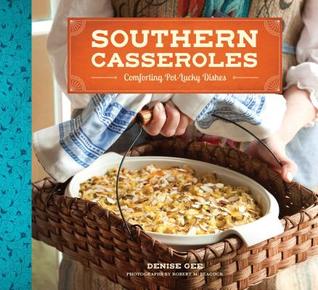
Southern Casseroles by Denise Gee

Southern Casseroles by Denise Gee

This book not only had TONS of casserole and casserole-type side dish recipes, but I really liked that the author gave a lot of good tips at the beginning of the book. She walked through pantry staples to keep on hand, how to determine what size dish you need to cook your casserole in, basic recipes for sauces and types of casserole toppings. There are definitely a few recipes I'd like to try - the squash casserole, corn casserole, and two variations of sweet potato casserole are at the top of my list to try. I would definitely recommend this one to casserole and/or Southern food fans.


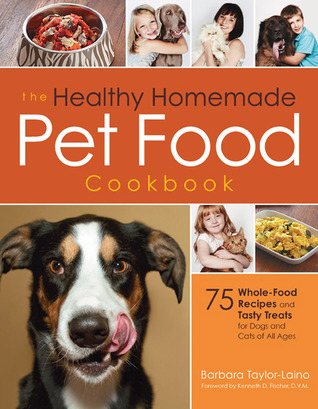
The Healthy Homemade Pet Food Cookbook by Barbara Laino

The Healthy Homemade Pet Food Cookbook by Barbara Laino

In theory I would LOVE to be able to make homemade pet food for my cats. A few years ago when my husband and I drastically changed our diet by only buying our meat and milk at the farmer's market and as much produce as I can too, I reevaluated our cat's food too and changed them to a more natural-based cat food (Blue Buffalo) that doesn't have any "animal by-product" included. I figured if I didn't want to eat mystery meat from the grocery store why should my cats eat the even worse by-products left over from that mystery meat! As much as I would like to make their food it would be pretty pricey. Plus, one of my cats is pretty picky and the other LOVES any kind of food. I could see one cat eating all the homemade food and the other one either not getting much or forcing me to have to feed them separately. I think the premise is great, but not realistic for most people. I did appreciate that she does include a list of some "high-quality commercial food brands" as well. Overall, if you have lots of extra time and money this would be great for your pets.


The Farmstead Egg Guide & Cookbook by Terry Blonder Golson

I really liked this book. It was half how to raise chicken and half egg recipes. I don't have chickens (yet), but I imagine if you have a few you will need lots of different recipes to use up all the eggs you'll get. The author even talks about how to freeze eggs which I'd never heard of before. There were quite a few recipes I'd like to try and I would definitely come back to this one when/if I get some chickens someday. I would definitely recommend this one!


Modern Pioneering by Georgia Pellegrini

I think the title of this book is a little misleading. It's mostly recipes and there is information about gardening, even on a very small scale, and looking for and using wild edibles. There was also a little information about canning, but I would recommend reading more than one chapter in a book before canning at home! There were a couple recipes I'd like to try. Overall, it was pretty good, but not great or amazing.


The Italian Vegetable Cookbook by Michele Scicolone

I love Italian food, but often Italian cookbooks are a little complicated and mostly pasta (which I don't mind). This one is all vegetable recipes, but not just side dishes, there are also sandwiches, soups, pasta of course, sauces, side and main dishes, and desserts - all vegetable centered. There are a few recipes I'd like to try and overall I liked that it had a wide variety of recipes and dishes.

March 2014 Reviews

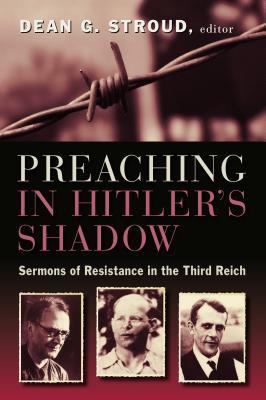
Preaching in Hitler's Shadow by Dean G Stroud

Preaching in Hitler's Shadow: Sermons of Resistance in the Third Reich by Dean G. Stroud, ed.

This is an incredibly inspiring book! While I knew the Nazis used all kinds of propaganda to promote their distorted racist beliefs, I didn't know that they purposely targeted the Church and tried to initially promote Nazism as a "Christian" based government, then shortly re-wrote the Bible to exclude anything about Jews (which needless to say is pretty much ALL of it)! Pastors during this incredibly difficult time had to decide whether to stand against the Nazis at their own personal risk or keep quiet. The first part of the book explores how Nazism tried to infiltrate the Church and how pastors stood up against it - many of them dying in concentration camps because of their stand. The second part is a collection of sermons. Each chapter gives background information on the pastor, background on the sermon, and the actual message. I can't even imagine living during that time and facing down that kind of evil. These men show that no matter how dark the days God's light still shines from His believers. 

Quotes I really liked:

"Bonhoeffer told the Christians that they had to aid victims of Nazi persecution, regardless of religious affiliation or status in the Nazi state. If persecution continued, then Bonhoeffer suggested yet a third step. This measure was one that he ultimately would take himself, and it would cost him his life. 'The third possibility is not just to bandage the victims under the wheel, but to jam a spoke into the wheel itself.' Here Bonhoeffer's Christian faith required political and self-sacrificing opposition. His way of 'jamming a spoke' into the Nazi wheels that were crushing Jews would be to join those plotting to kill Hitler." (p. 37)

"As life became more and more difficult in Germany, Bonhoeffer accepted an invitation to teach in the United States, but soon after his arrival he decided to return to Germany. Bonhoeffer left New York for Germany on July 27, 1939. A little more than a year later, in September 1940, Bonhoeffer, like so many other pastors, was officially banned from preaching and speaking in the Third Reich...After his arrest in April 1943, Bonhoeffer continued to be a model of Christian courage...Dietrich Bonhoeffer refused to allow prison confinement to silence Christian witness. By special orders of Hitler, Bonhoeffer was hanged on April 9, 1945, just days before Germany surrendered." (p. 52-3)

"The sermon included here [by Karl Barth] was preached just at the end of Hitler's first year as chancellor. Its theme is Jesus as a Jew. Copies were made the following day, and Barth even sent the sermon to Hitler. The Jewishness of Jesus offended some in the church, and they walked out. Writing later to a woman from the church, Barth insisted that one simply cannot sever Jesus from his Jewishness: 'anyone who believes in Christ, who was himself a Jew, and died for Gentiles and Jews, simply cannot be involved in the contempt for Jews and ill-treatment of them which is now the order of the day.'"(p. 64)

"I would rather die for my faith than live a cowardly and cultured life with the rest of the world. For nowhere is it said that God will allow us in all circumstances her to live the little span of earthly life without going through loss of money, property, honor, life and limb, wife and child. Even more, such sorrows must come upon the Christian at times; but the Lord brings the little boat of the church through the stormy seas of human events, which must grow calm at his word." (p. 84 -Paul Schneider)

"It is inside us all; this truth that upright men and women can turn into horrible beasts is an indication of what lies hidden within each of us to a greater or lesser degree. All of us have done our part in this: one by being a coward, another by comfortably stepping out of everyone's way, by passing by, by being silent, by closing our eyes, by laziness of heart that only notices another's need when it is openly apparent, by the damnable caution that lets itself be prevented from every good deed, by every disapproving glance and every threatening consequence, by the stupid hope that everything will get better on its own without our having to become courageously involved ourselves. In all these ways we are exposed as the guilty people we are, as men and women who have just enough love left over for God and our neighbor to give away when there is no effort or annoyance involved." (p. 122-3 - Helmut Gollwitzer)

"Now just outside this church our neighbor is waiting for us - waiting for us in his need and lack of protection, disgraced, hungry, hunted, and driven by fear for his very existence. That is the one who is waiting to see if today this Christian congregation has really observed this national day of penance. Jesus Christ himself is waiting to see." (p. 126 - Helmut Gollwitzer)

"The Christian faith is not something that lets us rest. It is not simply the possession of the conviction of certain teachings that one can make one's own once and for all. Rather the Christian faith is an attitude of the will. It is only alive in us when it continually proves itself in new ways. It does not suffice to have decided for faith in God once in the past, but rather this decision for faith has to be implemented anew time and time again whenever he encounters us, when his call meets us. Always again it remains true: Now! Through his encounters God puts us to the test. To be ready for his call, that demands from us that we keep an inner detachment from everything that has a claim on us, from our work and cares, from joys and sorrows; that nothingentirely claims us, lest we become blind for his encounter and deaf to his call." (p. 153 - Rudolf Bultmann)

"How many behave like this with Jesus. For a period of time his is okay. But when things head into the dark, into the dying of the old man, into the shattering of our wishes and hopes, then one says: 'That is going too far. I am turning around.' True faith, however, goes with the savior even into the darkness. Thus we read of Abraham (Heb. 2:8): 'By faith Abraham was obedient when he was called to go out...and he went out and did not know where he was to go.' He went with Jesus into the darkness and the unknown. And one day the command came that he should sacrifice his only son on Mount Moriah. He did not scream: 'That's going too far!' but rather he went comforted by faith along this dark path that led ultimately to light." (p. 176 - Wilhelm Busch)


Mr. Penumbra's 24-Hour Bookstore by Robin Sloan

Mr. Penumbra's 24-Hour Bookstore by Robin Sloan (book club)

This was one of the most unique books I have ever read. But, it was also kind of all over the place so I didn't love it. Clay Jannon has been hit by the Great Recession and is desperately in need of work. His last job was in web design, but he just sort of learned what he needed to on the fly. He stumbles upon Mr. Penumbra's 24-hour bookstore and ends up working the graveyard shift there. He quickly realizes something is different about this bookstore since only half of the books are actually for sale and the rest are reserved for members to some sort of secret society. Clay's boredom leads him to start learning computer code and trying to recreate the books taken by the society members. Unknowingly Clay breaks the code that all these members have been working on. That opens the door for Clay into a secret society where old-school books are pitted against new computer technology in a power struggle between members. By being able to appreciate both old and new technologies Clay is able to figure out secrets that the secret society has been working on since its existence. Sloan manages to work Google, tech start-up companies, a sci-fi author, and an ancient secret society all into this crazy book and it somehow works.


Bargain Fever  by Mark  Ellwood

Bargain Fever: How to Shop in a Discounted World by Mark Ellwood

I thought I was going to like this book more than I actually did. I read a few other reviews that said the book dragged as it went along and the first few chapters were the best, which I definitely agree with. I really enjoyed the chapter about coupons and how that whole thing got started. It was also interesting to learn that the very first coupon EVER was for a free Coca-Cola to get people to try the new drink. There was also some interesting information about how sales and discounts affect our brain. I can say from experience that saving a lot of money by combining coupons and sales IS like a high. There was also some stuff about why high-end fakes (mostly purses) is such a huge problem. Overall, I thought the book was VERY wordy and detailed and a lot of it was information I just wasn't super interested in. There were some interesting facts, but I don't think I would recommend it to anyone.

A few quotes I did like:

"Supermarkets after World War II stocked an average of 3,750 items; by the end of the twentieth century that number had increased more than tenfold, to 45,000. In 1994, the total of UPCs for consumer products - in other words, things that could be sold at a store by scanning them - was just over five hundred thousand. Less than ten years later, it had reached almost seven hundred thousand. In 1980, there were six major blue jeans brands in America; thirty years on, that number was eight hundred and climbing. We have enough excess possessions to birth not just a TV show about self-storage but also a booming industry. In 2012, there were 2.3 billion square feet of storage space in this country, and more added since. One in ten US households was renting some kind of unit, an increase of 65 percent since the late 1990's." (p. 6)

"To celebrate [American Girl dolls] twenty-fifth anniversary, the firm teamed up with Celebrity cruises to offer a week-long trip to the Caribbean aimed at American Girl fans. The package included cooking classes, chats with authors of some of the books, and a giant birthday party. The ship sold out in forty-eight hours." (p. 157) - this is some craziness! A week cruise aimed at 8-10 year old girls?! Wow.


The Whole Golden World by Kristina Riggle

Morgan Monetti never intended to fall in love with her calculus teacher, but she did and she continues to shock her parents and the community when she stands by TJ even after he's arrested for their relationship. Morgan doesn't feel like a victim of a predator, she believes she's a young woman who happened to fall in love with her teacher, who's not even thirty yet. Morgan's mother, Dinah, wants justice for her daughter. Morgan might not believe she's a victim, but Dinah does. Dinah wants the full force of the law to come down on TJ, but Dinah didn't realize how the whole town would turn against her family too. She's trying to keep their family together through this insane ordeal. Rain is TJ's wife and she's standing by her husband as well. At least in the beginning when she still believes his story, but as more of the truth comes out Rain has to decide what's best for her, not just what's best for TJ. Told from each woman's perspective, The Whole Golden World explores all sides of an inappropriate teacher-student relationship. Each woman copes with the situation differently, but all are deeply affected and forever changed by the consequences of this relationship. 

Overall, I thought the storyline was good and each woman's character is well developed. A few of the scenarios at the end of the book seem a little too far-fetched to be realistic, but the storyline overall flows well and you can clearly see each woman's side of the story. The ending made sense and wrapped up each character's story well. I thought it was good, but not amazing.


Mud Season by Ellen Stimson

Ellen Stimson knew the very first time she visited Vermont that she wanted to live there someday. She and her husband were both from St. Louis, Missouri, but never felt any special attachment to their hometown. When Ellen's decided to sell her half of her book business to her business partner, she decided this would be the perfect time to live her dream of moving to Vermont. Packing up their life, 3 kids, 2 dogs, and 2 cats proved challenging at best and their dream house in Vermont turned out to be somewhat of a money pit, but they were now living in Vermont. Soon after their move Ellen finds out the local country store is up for sale and they impulsively decide to buy it. For all of Ellen's dreams about revamping the country store, the locals are not thrilled with her changes - or any changes. She quickly butts heads with many of the locals about the store, the local schools, the contractors she hires to work on her house, etc. Eventually Ellen has to re-evaluate their decision to buy the local country store, but for all the crazy disasters and disappointments Ellen never doubts their decision to move across the country to Vermont and her family still lives there today.

This was one of those everything-that-can-will-go-wrong-but-in-a-funny-way kind of books. At times you feel bad for them and at times you think how can they not see how crazy this is, but it was a funny book that I read pretty quickly. I did appreciate how Stimson was real and didn't sugar-coat the downsides to their move and decision to buy the country store. Overall, it was pretty good but there were a few things I didn't like which is why I didn't rate it higher. Good, but not great.


Stella Bain by Anita Shreve

During World War I, an American woman wearing a British nurse's uniform wakes up in a field hospital in France with shrapnel wounds to her feet. She has no memory of who she is other than the name Stella Bain and does not know why she is in Europe or how she became trained as a nurse. Soon she feels compelled to visit the Admiralty in London, but soon after arriving becomes very ill and is taken in by a cranial surgeon and his wife, Dr. August and Lily Bridge. Dr. Bridge quickly realizes that Stella is suffering from traumatic amnesia and starts to help her get her memory back. Stella wants nothing more than to remember her past, but she is also afraid of what she might remember. When her memory does come back the storyline quickly moves through her past and the reader follows her back to America to try to re-gain her old life. The way Shreve lays out the story not in chronological form, but rather in time with Stella's memories is fantastic. You can almost feel Stella's emotions with her. This is one of the best books I've read in a LONG time! I've been a fan of Anita Shreve for a long time, but I haven't loved some of her last few books. But, I could not put this one down it was so good!


Paris Letters by Janice Macleod

This book was so inspiring and such a quick, fun read. Janice MacLeod was working in advertising as a copywriter in L.A. Her life looked great on the outside, but she was miserable. One day she decided to see how much it would cost for her to quit her job for a year to figure out a new career path. She decides to try to save or not spend $100 a day. Within a year she's saved a whopping $60,000! She quits her job and decides to travel around Europe for the first few months. Her first stop is Paris, where she almost immediately falls for a butcher working near where she is staying. She doesn't speak French well and he doesn't speak English, but they manage to communicate enough to start a relationship. MacLeod doesn't think this is going to necessarily go anywhere, so she continues with the rest of her planned travel around Europe. But, when Christophe, the hot butcher, asks her to come back to Paris "to see" she does and the rest is history. She still has to figure out a way to make money if she stays in Paris, so she combines two of her loves - painting and letter writing and starts selling painted letters on Etsy and through her blog. MacLeod's story shows that sometimes it's worth taking a big risk to get a big reward. While not everyone can quit their life and move to Paris, this book still makes you think about how to enjoy your life more and whether a steady, boring job is better than a cheaper, happier life.
Sunday, February 23, 2014

February 2014 Reviews

Defending Jacob by William Landay

Defending Jacob by William Landay (book club)

I had a hard time getting into this book and I really did NOT like the author's style/tone of the book. After I read the first 1/4 of it I was interested enough in finding out what really happened that I did want to keep reading. The basic premise is that a 14-year-old boy, Ben Rifkin, is murdered. Head Assistant District Attorney, Andy Barber, is working with the local police on the case. The murdered boy attended the same school as Andy's son Jacob. Then Jacob is charged with the murder and Andy is forced to take a leave of absence from his job. As Andy helps fight for his son he and his wife begin to question everything they know, or don't know, about their son. Andy believes in Jacob's innocence to the very end - he can't even conceive that Jacob could do this. There is a twist at the very end that I won't give away, but I can say that I didn't see it coming.

Overall, I really didn't like the main character and narrator, Andy. He started to seem like a sociopath who didn't have any real emotions and it did make the reader question him and the family more. I also felt like the whole tone of the book was kind of harsh and almost vulgar like the author was trying really hard to make Andy out to be a hardass kind of guy. The storyline was interesting and since I read this for book club I think it will make for a really good discussion, but I don't think I would recommend this one. Other authors like Jodi Picoult have tackled similar issues better.


Growing a Feast by Kurt Timmermeister

Growing a Feast: the Chronicle of a Farm-to-Table Meal by Kurt Timmermeister

Kurt Timmermeister lives on the 13-acre Kurtwood Farms on Vashon Island in Washington state. Kurt was a chef and originally bought the farm when it was smaller to try to grow more of his restaurant's food. He now is a full-time dairy farmer creating artisan cheese from his cow's milk. He also regularly hosts farm-to-table dinners for paying friends and guests that showcase all the abundance of food the farm creates. This book shows all the work that goes into one of these farm-to-table meals. It starts two years before the actual meal with the birth of a calf who will come to be one of Kurt's best milk producers. He also goes through the cheese aging process which can take up to 18 months. The book was very interesting and it shows just how much work goes into food production, which I think most people completely take for granted and are very removed from. He also includes a few of the recipes from the farm-to-table dinner at the end of the book. My only complaint was that the book was VERY detailed - lots of very detailed descriptions of every single activity and every step in every process, recipe, etc. I could have gotten the picture without so much detailed description. I still would like to read his previous book "Growing a Farmer" which chronicles the creation of Kurtwood Farms and how Kurt began living off his land as a farmer. Overall, I liked it, but it was a little too detailed and overly descriptive for me to rate it higher. 

"I have slaughtered many animals - pigs and cows and chickens - here in the past decade. It has become part of my life now. It is only when someone walks around that corner and sees a large dead animal hanging that I am reminded how unusual this seems. That does strike me as somewhat sad. Most of us eat beef or pork most every day, and yet can spend our entire lives never observing the slaughter and butcher of the meat that will become our dinner." (p. 130)


The Edge of the Earth by Christina Schwarz

The Edge of the Earth by Christina Schwarz

In 1898 a woman has very few options in the world. Trudy, who grew up in comfort in Milwaukee, Wisconsin, is expected to marry her long-time beau and friend Ernst and raise a family with him. But, when she is re-introduced to Ernst's cousin Oskar, she quickly falls in love with his impetuous and carefree nature. They quickly marry and move from Wisconsin to California to work as lighthouse keepers at Point Lucia. Oskar thinks working at the lighthouse will help spark his creativity; he wants to design an electric engine. Trudy just wants to experience something completely new and different. But, life is hard on an isolated lighthouse. There is the head light keeper Mr. Crawley and his family, as well as the second light keeper Archie Johnston, Mr. Crawley's brother-in-law. Trudy is quickly put in the role as teacher to the Crawley's four children. As Trudy and Oskar learn more about life at Point Lucia, they start to uncover a few of Point Lucia's secrets. One of those secrets will swiftly change Trudy's life forever.

This was a really fascinating book. The storyline was very unique and they way everything quickly unfolded made you want to just keep reading to find out what would happen next. I would have never guessed the secret Trudy uncovers and the end was a surprise too. Overall, I was very impressed with this book and I would highly recommend it!


Wonder Women by Debora L. Spar

Wonder Women: Sex, Power, and the Quest for Perfection by Debora L. Spar

I really enjoyed this book and thought that Spar brought up a lot of really good information. She grew up never identifying herself as a feminist, thinking feminism's work was done. After becoming one of the youngest female professors to be tenured at Harvard Business School and having three children, Spar began to realize that "having it all" wasn't as easy as she'd been told. She also quickly realized that feminism's work still had a long way to go. Wonder Women does a good job of combining statistics and data with Spar's personal experiences and stories from other women. Spar covers everything from dating, sex, and marriage, to trying to balance work and family, to how women view aging and beauty. While I did feel like the very end of the book was a little repetitive, overall I wholeheartedly agreed with almost everything she said. To me this book and similar ones like Lean In just go to show how much feminism has achieved, but how there is still a long way to go.

Some quotes I really liked:

"National networks and newsmagazines, for example, doted on the more extreme elements of radical feminism, highlighting Firestone's claim that 'pregnancy is barbaric,' or Atkinson's assertion that 'love has to be destroyed.' More mundane stories about women working for the ERA or supporting Planned Parenthood, by contrast, rarely made headlines, creating a massive asymmetry between the sprawling contours of the actual women's movement and popular perceptions of feminism. For women who were already in the movement, this unbalanced portrayal was a source of great contention. For those of us who were just a few years younger, however, what we saw was only the news. We grew up, as a result, with a skewed sense of feminism and a vague belief that all feminists hated men, denounced children, and refused to wash their hair." (p. 26)

"In 1982, the American Society of Plastic and Reconstructive Surgery classified small breasts as a deformity. Today, nearly 12 million Americans a year choose to undergo either cosmetic surgery (like breast implantation) or nonsurgical cosmetic procedures (like laser skin resurfacing). These numbers have increased by nearly 500 percent since the American Society for Aesthetic Plastic Surgery started collecting its data in 1997." (p.94-5)

"More profoundly, Wolf and others who write in this vein suggest that the myth of feminine beauty has been subconsciously designed to undermine the triumphs of feminism, to push women out of the spheres of power and, expensively and compulsively, back into the personal realm. Because when women aspire to an unobtainable and usually ill-fitting standard of beauty, they effectively consign themselves to years of fruitless labor and frustration, ceding power in the process to less-encumbered men." (p.97)

"One place to start might be with the raft of self-help books devoted to these issues [related to marriage]...Interestingly, the vast majority of these titles address themselves to women rather than men. And scarily, most adhere to a starkly conservative line, essentially exhorting women to revert to the Good Wife's rules. In The Proper Care and Feeding of Husbands, for example, Dr. Laura Schlessinger perkily tells her readers (millions of whom also tune into her internationally syndicated radio show) to 'forgive their husbands...for being men.' Women, Schlessinger scolds, are unhappy because they are self-centered; because they are focusing on what 'their men can do for them, and not what they can do for their men.' The simple remedy, therefore, is to treat husbands better, to 'roll over in bed, close your eyes, give him a big hug, and remember that, without him, you are only a sorry excuse for a person.' Not exactly Gloria Steinem stuff." (p. 166)

"Feminism, in other words, was meant to be about expanding women's roles and choices; about giving them freedom, for the first time in history, to participate with men as equals, and to use their minds and bodies and talents and energies as they desired. Yet somehow this expansive and revolutionary set of politicalgoals has been squeezed - or hijacked or mistaken - into something much more narrow and personal. Rather than trying to change the world, women are obsessed too often with perfecting themselves." (p. 170-1)

"Because if organizations reveal the gender biases of those who control them, then historically male places (like Wall Street, or automobile manufacturers, or oil rigs) will naturally tend to be harder on women, and to promote only those women who, in essence, behave 'like men.' Which helps to explain why so many sectors of the modern economy get stuck at female participation rates of 15 to 20 percent. These are women who either naturally, or by sheer force of will, learn how to operate in what remains a male-driven environment. Their presence, however, does not mean that women have actually entered into this club on equal footing, which is why the numbers prove so resistant to change." (p. 176)

"Less obviously, and for more complicated reasons, women remain sexualized to an extent that men rarely are, and they feel the impact of their physical attractiveness in a much more direct and pervasive way. This aspect of women's lives might well have been eviscerated by the feminist and sexual revolutions. In fact, eliminating women's status as sexual icons for men was one of these revolutions' earliest goals. But it didn't happen. Instead, looser norms of sexual conduct, combined with the exploding realm of digital media, have brought us to the world of Toddler and Tiaras and pervasive online pornography. Not only are women's bodies arguably more objectified than ever, but the object of all this desire has been airbrushed and Photoshopped nearly beyond recognition, pushing women toward standards of bodily perfection that are literally no longer human." (p. 233)

A Place at the Table by Susan Rebecca White

A Place at the Table by Susan Rebecca White

This was a really unique book that just drew me in from the very first page. A Place at the Table brings together three very different people all through one Manhattan restaurant, Cafe Andres. White does a great job bringing together Bobby, a young gay man from Georgia who's estranged from his family, Amelia, a wealthy Connecticut woman who uncovers a deep family secret, and Alice, an African-American woman from North Carolina who's an accomplished chef and cookbook author. For most of the book it's a mystery how these three stories will be related at all, but toward the second half of the book everything begins to come together perfectly. Each of these characters will be profoundly changed by their interactions with each other. This was a unique story that I would highly recommend.

I was really very impressed with how seamlessly White brought these very different stories together. It did not seem rushed or too perfect, but very natural. I will definitely check out some of her other books.

January 2014 Cookbooks

I love to look at cookbooks even though I will probably never have the time to try all the recipes I find.  Last year I started keeping track of the cookbooks I look at in addition to all the books I read.  Since you don't really "read" cookbooks the same way you read other books I wanted to keep them separate from the regular books I read.  I'm going to do my cookbook reviews on this blog the same way I do my other reviews by grouping them together by the month.  In January I only looked at one cookbook, so here's that review.

Eat Ink by Birk O'Halloran

Eat Ink: Recipes, Stories, Tattoos by Birk O'Halloran

I love cookbooks and I love tattoos, but I wasn't impressed with this book. The premise is to showcase a "signature" recipe from a tattooed chef. Each chef has their bio and a little bit about why they are into tattoos or any significant tattoos they may have. I was surprised to see many of the chefs featured only have 1 or 2 tattoos. And of course with only 1 tattoo you are considered "tattooed," but I think of someone who is "tattooed" as someone with sleeves or multiple visible tattoos. I think it was kind of a stretch to create a book like this. I would have rather seen more of a photo book with just pictures of chefs with their tattoos and maybe a little bio and info about their tattoos. I also didn't even see one recipe I wanted to try. Overall, I was unimpressed. I think this idea just didn't really work out well in print.

Sunday, January 12, 2014

January 2014 Reviews


I love to read and I read a wide variety of both fiction and non-fiction, but my favorite is non-fiction.  So, periodically I'll read only non-fiction for a month .  I decided to start 2014 off by reading only non-fiction in January.  Here are my reviews (originally posted on Goodreads):


Pandora's Lunchbox: How Processed Food Took Over the American Meal by Melanie Warner

This book scared the hell out of me! In Pandora's Lunchbox Melanie Warner traces the history of processed food and why it's such a huge industry today. Some of the history seems like scientists and other food industry people were actually trying to help people by preserving food for longer, but now we basically have a big-money system that is pumping "food" full of all kinds of chemicals and processes that we have no idea how they will affect us long-term. Two of the scariest things to me were GRAS (Generally Recognized as Safe) which means companies can add whatever they want to their food if they stipulate that it's "generally recognized as safe" for human consumption instead of trying to get their additive approved by the FDA. The other scariest thing is how much soy is added to food and not just food we think of like vegetarian "meats," but also supposedly real meat - it's added to cut costs because it's cheaper to put up to 25% soy into "real" chicken nuggets than actually use 100% real meat. If this book won't inspire you cut out completely or at least cut back significantly on processed food I don't know what will! I try to eat mostly food from the farmer's market and mostly whole food that I cook myself, but this book definitely inspired to try to make my own bread from scratch after reading about all the dough conditioners that are added to even "healthy" bread. Here are some quotes I particularly enjoyed:

"As a general rule - in a universe of tens of thousands of foods, there are always exceptions - a processed food is something that could not be made, with the same ingredients, in a home kitchen. Your home kitchen." (p. xvi)

"When consumed in excess, sodium-based additives are troubling because they bypass the body's ability to detect and regulate sodium intake. Oversalt your food at home, and it's unlikely you'll be able to remain unaware. Probably you'll end up finding something else to eat." (p. 46-7)

"In fact, vitamins and minerals are so thoroughly embraced that they're the only synthetic ingredients with carte blanche approval for inclusion in certified organic products, even when those vitamins and minerals are produced with genetically modified (GM) bacteria or have been synthesized from noxious petrochemicals. GM technology and toxic chemicals are otherwise banned from organics." (p. 80) [This is why the "organic" label is virtually meaningless to me.]

"But while studies routinely show that various fruits and vegetables are effective in warding off modern ailments like cancer and heart disease, the same can't be said for synthetic vitamins. According to a whole spate of recent studies, most of which were done on pills, not fortified foods, supplemental vitamins fail to offer the health benefits we once thought they had. In some cases, taking large amounts of these compounds appears to have exactly the opposite effect, increasing your chances of getting diseases like cancer." (p. 85-6)

"There's an ocean of difference between actual fruits and vegetables and the phytochemicals that may appear one day in products at the supermarket (and that are already sold as supplements at GNC). Like vitamins, they will not be derived from their edible hosts but produced synthetically, the vastly more efficient and economical route. Most companies selling lycopene as a nutritional supplement, for instance, are making it from chemical synthesis, not prying it from tomatoes...There's no money to be made in publicizing the fact that apples are healthy, but the commercial appeal of a blueberry cereal bar with blueberry anitoxidants or a multigrain bread with anticancer wheat-bran compounds is obvious and compelling." (p. 94-5)

"Rather, it's the monumental quantities [of soybean oil] we're ingesting that distort our bodies' critical ratio of omega 6 and omega 3 fats. The ideal proportion is somewhere between one and three omega 6 fats to every one omega 3. That's roughly what it's been in most cultures throughout human history. Today the ratio in the American diet is about ten to one, and our cells are flooded with omega 6s. This dietary imbalance is thought to have a number of far-reaching implications for human health. Many in the medical community thing it is a contributor to heart disease, many forms of cancer, depression, and various other diseases that stem from inflammation. Soybeans in our diet are the primary reason for this dangerous imbalance...In a 2011 study, Joe Hibbeln of the National Institutes of Health (NIH) found linoleic acid levels (omega 6) in modern ground beef, pork, bacon, chicken, beef tallow, and lard higher than in animals raised according to practices used in 1909 - methods that Hibbeln asked Joel Salatin of Polyface Farms in Virginia to replicate for the study. They ranged from 12 percent to 40 percent higher for chicken and pork, to 200 percent and 300 percent higher for bacon and ground beef. Modern omega 3 concentrations were higher too, but not enough to offset the leaps in omega 6." (p. 141-2)

"While in St. Louis, I asked Michele Fite, Solae's vice president of global strategy, whether people might feel unhappy about soy tucked into their chicken sandwich. She had a quick answer. 'The people that are eating things like Banquet frozen meals aren't concerned about this,' she said, motioning to Orcutt's boxes." (p. 156) [Basically we make products for stupid people who don't care what they eat!]

"I was interested in the messages food companies have delivered about the basic human art of cooking over the years, and the discourse turned out to be remarkably consistent. Among the dozens of commercials I watched at the Paley Center, all of them that had something to say about cooking were tailored around a simple idea: messing around in the kitchen is a cumbersome, time-consuming chore. Why bother with such labor when drive-throughs can be visited and trays deposited into microwaves?" (p. 204)


The Happiness Project by Gretchen Rubin

This was a very fascinating book! The author's premise is basically to spend a year trying to be happier. This seems like a very vague idea, but she breaks it down into monthly goals and then each monthly goal has sub-goals as well. It might sound complicated, but it actually makes a lot of sense. I especially appreciated that she notes throughout the book that everyone's Happiness Project would look different - no everyone will be happy with the same things. I think that is what give a lot of appeal to this book - the fact that if I chose to do something similar it would be about what goals I wanted to focus on or things I wanted to try, not trying to do exactly what this person is telling you will make you happy. Definitely an interesting and inspiring book! Originally read Dec. 30, 2010

Re-read Jan. 9 2014 for bookclub

I still really enjoyed this book. I really enjoy Rubin's tone and style of writing. She seems like she could easily be one of your friends. She definitely inspired me to organize more and go through my closet. Here are two quotes I really enjoyed this time:

"The fact that the happiness boost that hits at the cash register isn't particularly admirable doesn't mean that it's not real - or that it doesn't shape people's behavior. Research and everyday experience show that receiving an unexpected present or being surprised by a windfall gives people a real boost; in one study, in fact, when researchers wanted to induce a good mood in their subjects to study the effects, the way they accomplished this good mood was to arrange for those subjects to find coins in a telephone booth or to be given bags of chocolate." (p. 173) [This is why finding change on the ground and saving money with coupons makes me so happy!]

"Satisficers (yes, satisficers) are those who make a decision or take action once their criteria are met. That doesn't mean they'll settle for mediocrity; their criteria can be very high, but as soon as they find the hotel, the pasta sauce, or the business card that has the qualities they want, they're satisfied. Maximizers want to make the optimal decision. Even if they see a bicycle or a backpack that meets their requirements, they can't make a decision until after they've examined every option, so they can make the best possible choice." (p. 182)
[I am a satisficer and my husband is a maximizer - he researches EVERYTHING for months before making a decision!]


The Mushroom Hunters by Cook, Langdon

The Mushroom Hunters: on the trail of an underground America by Langdon Cook

This was such an interesting book. I never knew much about mushrooms, but I think foraging for wild food is a very interesting topic. Apparently because of the nature of how mushrooms grow, most of the mushrooms used in restaurants are foraged from the wild by mushroom hunters. Langdon Cook became interested in foraging for food, but became obsessed with mushrooms. He was introduced to Doug, an experienced mushroom hunter, and Jeremy, a mushroom buyer/broker. Cook spent months with both Doug and Jeremy learning about the wild edible business. It was a fascinating look at a kind of underground industry. My only complaint was that toward the end it was a lot of the same information - just hunting different mushrooms in different woods, but very similar to a lot of the rest of the book. But, overall I really liked it and it was a very unique and interesting book.


The Feast Nearby by Robin Mather

The Feast Nearby by Robin Mather

The Feast Nearby was a quick and fun read. In 2009 Robin Mather's husband asked for a divorce and then the next week she was let go from her job as a journalist with the Chicago Tribune. She needed to completely revamp her life. Her only work was from freelance jobs, so she knew her budget had to be cut back extensively, but as a food writer she also didn't want to deprive herself of good food. Thankfully Mather shows the reader that you can eat VERY well on a budget and locally. She divides this book into 4 sections reflecting the 4 seasons of the year and after each chapter she includes a few recipes too. While, her story is inspiring - how she picked herself up and started over - some of it comes across a little too perfectly. She's broke and of course her next door neighbor has a huge garden and gives her TONS of produce - of course that happens, but not everyone would be so lucky. 

I did really appreciate how she reiterated how easy cooking is - that it's not something hard and arduous, but can be very enjoyable and is usually easier than you think. She also reiterates the value of canning and preserving seasonal local produce to have it year round. Overall, I did really like this book and I want to try out a few of her recipes. It made me wish I could work from home and have more time to cook and preserve food year round.

A quote I really enjoyed:

"I guess we all define 'comfort food' a little differently, though...I mean to say that the foods you ate as a child will be the ones that comfort you as an adult. If you're raising children now, you might pause for a moment to consider that. Are your children going to become adults who think chicken McNuggets are the most comforting thing in the world?" (p. 211)


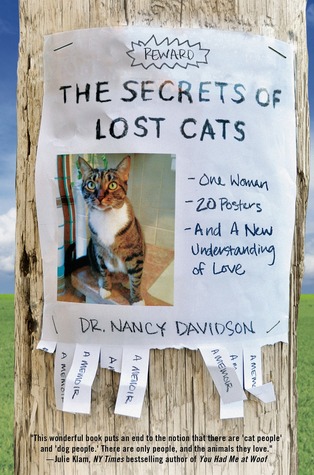
The Secrets of Lost Cats by Nancy   Davidson

The Secrets of Lost Cats by Nancy Davidson

I thought this would be an interesting book, and parts of it were, but overall I wouldn't recommend it. After Nancy Davidson's cat Zak goes missing and she creates a lost cat poster, she can't help but notice other lost cat posters wherever she goes. She also starts collecting the lost cat posters and contacting the owners to hear their story and find out if their cat was ever found. A few of the stories are really interesting, but then a lot of the stories are sad or the owner doesn't want to talk - I guess she only included those to show the range of reactions from the pet owners. Davidson is also a therapist and so she goes into a LOT of detail about how people react to stress/loss/emotions/etc. She also goes into a LOT of her own personal history and somehow tries (not successfully in my opinion) to tie that into these lost cat stories. Overall, it was disappointing. I think the idea of following up with lost cat owners to see what happened is an interesting idea, but in this book it didn't play out too well in my opinion. I love animals, cats especially, but I wouldn't recommend this one. 

She did include some helpful tips at the end of the book about finding your lost cat and what to do if you find a seemingly lost cat. She also encourages people to adopt pets through the Humane Society, which is definitely appreciate.


One-Woman Farm by Jenna Woginrich

One Woman Farm by Jenna Woginrich

I wasn't impressed with this one. I really liked her earlier bookMade From Scratch, but I wasn't impressed with Barnheart orOne Woman FarmOne Woman Farm was more of a short diary of Woginrich's life as a "one woman farmer." Some things she wrote about were interesting, but overall it was just very over-the-top and romanticizing of the farmer's lifestyle. Don't get me wrong I think we need to move CLOSER to a smaller farm food system and I am all about growing my own food and I will probably have bees and chickens of my own one day soon, but she just went on and on and on about how great it is to get up at 5am and feed a bunch of animals and then do it all again that evening too. It almost seemed fake because it was so over the top. I guess I may have to stop reading her future books because I have not enjoyed the last two at all. I would not recommend this one.


Running Like a Girl: Notes on Learning to Run

Running Like a Girl by Alexandra Heminsley

When Alex Heminsley decided she wanted to start running she figured it would be easy. She'd been walking long distances regularly, so how hard could it be to try running? Really hard as she quickly found out. But, Alex kept at it and with the encouragement of her family and the goal of running a marathon with her brother, she succeeded in becoming a real runner. After her first marathon Alex briefly stops running, but soon realizes that it not only helps her fitness level, but also many other areas of her life. She basically says that she wrote a book she wished she would have read before starting to run. The first (larger) section of the book is Alex's journey from couch potato to runner. The second (smaller) section of the book is helpful Q&A about running, injuries, what to eat, what to wear, etc. - basically all the helpful info Alex learned the hard way. The whole book is a very honest look at how hard running can be, but also how wonderful it can be once you get past some of the earlier hurdles. I really liked this book and it's inspired me to start (trying) to run!(

Friday, January 3, 2014

2013: The Year in Reading

I have been keeping track of the books I read each year since 2001.  For the past few years I've also picked my top 10 books that I read that year (5 fiction and 5 non-fiction).  In 2013 I also decided to keep track of how many cookbooks I read too.  In 2013 I read SO many great non-fiction books that I have some honorable mentions to include as well.  I read 88 books in 2013 and here are my top picks:

Top 10 Books of 2013

Fiction

Swimming at Night by Lucy Clarke
Gone Girl by Gillian Flynn
Me Before You by Jojo Moyes
Mouse Guard: the Black Axe by David Petersen
The Storyteller by Jodi Picoult

Non-Fiction

Gun Guys: a road trip by Dan Baum
Bootstrapper: from broke to badass on a northern Michigan farm by Mardi Jo Link
The Ethical Butcher: how thoughtful eating can change your world by Berlin Reed
Lean In: women, work, and the will to lead by Sheryl Sandberg
Comet's Tale: how the dog I rescued saved my life by Steven Wolf

Honorable Mention Non-Fiction

Saved: how I quit worrying about money and became the richest guy in the world by Ben Hewitt
Homeward Bound: why women are embracing the new domesticity by Emily Matchar
Cooked: a natural history of transformation by Michael Pollan
Gaining Ground: a story of farmers' markets, local food, and saving the family farm by Forrest Pritchard
Free Spirit: growing up on the road and off the grid by Joshua Safran

Cookbooks - I read 39 cookbooks in 2013 and these were my favorites

Biscuits by Belinda Ellis (I purchased this one)
The Smitten Kitchen Cookbook by Deb Perelman
Homemade with Love: simple scratch cooking from In Jennie's kitchen by Jennifer Perillo (I purchased this one)
At My Grandmother's Table: heartwarming stories and cherished recipes from the South by Faye Porter
Pure Vanilla:irresistible recipes and essential techniques by Shauna Sever
Southern Fried: more than 150 recipes for crab cakes, fried chicken, hush puppies, and more by James Villas