Tuesday, August 12, 2014

August 2014 Reviews

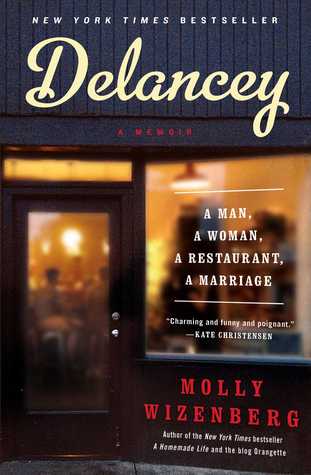
Delancey by Molly Wizenberg

Delancey: a man, a woman, a restaurant, a marriage by Molly Wizenburg

Molly Wizenberg's husband, Brandon Pettit, was always becoming interested in a unique topic or interest and then dropping it for the next one he comes across. So when he says he wants to open a pizza restaurant she thinks this is just another passing interest that will get dropped for the next thing, except it doesn't. Soon Brandon is signing a lease on a space and Molly is helping him renovate it to get it ready for the restaurant.Delancey is the story of Brandon's pizza restaurant of the same name, but it's also about how Molly had to learn to adapt to life as the wife of a restaurant chef (long, long hours most days), and how she came to understand who she truly is and who her husband truly is. He is great at running the restaurant and as much as she wanted to help and loves to cook - Molly is not cut out to be a restaurant line cook, that's just not who she is. Once she worked through all this she could finally enjoy Delancey for what it is and what it means to her husband. I admire Molly's honesty in this book about her mixed feelings about the restaurant and about her process for dealing with it and learning from it. This is a great book for any foodie readers out there. I loved Molly's first book A Homemade Life and I loved this one too! She also includes a few recipes either from the restaurant or just some of her favorites. I actually read this book in one day flying home from vacation - it's a quick, enjoyable read that will make you want to go grab a slice of pizza at your local pizza restaurant.

Real Food: What to Eat and Why

Real Food: what to eat and why by Nina Planck

I was so excited to read this book after reading Planck's cookbook The Real Food Cookbook, but it was kind of a let down. While I completely agree with everything she says about how real, traditional food is better for you than processed food, the book was very, very scientific and just had way too much statistics and facts bogging you down. While some of that is necessary in a book like this I just felt like it was so much science and data that it just became a chore to keep reading it. I really wanted to like it because I think she has a great message and obviously a LOT of data to back up her points, but it wasn't very interesting and engaging for me. I would still recommendThe Real Food Cookbook and eating a more traditional, real food diet that supports local farmers in your area.

A few quotes I liked:

"When a raw milk ban was proposed in New York City in 1907, a coalition of doctors, social workers, and milk distributors defeated it, arguing that safe milk should be guaranteed by inspectors, not pasteurization. In 1908, however, a panel of experts appointed by President Theodore Roosevelt concluded that raw milk itself was to blame for food-borne illness. That was the final blow. In 1914, New York required pasteurization of milk for sale in shops. Other states followed suit, and by 1949, pasteurization was the law in most places." (p. 73)

"The Journal of Dairy Science reported that 30 to 80 percent of conventional cattle carry E. coli in their stomachs, but when cattle were switched from a high-corn diet to hay, E. coli declined a thousandfold in only five days. In other words, a mere five days of feeding grass and hay to beef cattle before slaughter will restore the stomach to its normal acidity and kill E. coli, which would prevent many cases of contamination in the slaughterhouse. Unfortunately, this sensible, inexpensive practice has not been widely adopted by feedlots." (p. 102) [This is why you should support your local farmer for all your meat!]

"But there are some questions about vitamin supplements. The results of trials with supplements isolated from whole foods range from unhelpful (smokers taking beta-carotene had higher rates of lung cancer) to promising (vitamin E prevents second heart attacks) to merely equivocal (another vitamin E study on heart disease showed no effect). However, studies consistently find that diets rich in antioxidants from whole foods lower risk of heart disease and cancer." (p. 161)

"One dogged researcher, Mary Enig, helped to get the word out. The author of Know Your Fats, Enig waged an often lonely battle. I'm afraid her efforts were not always welcomed with bouquets of roses. In 1978, Enig wrote a scientific paper challenging a government report blaming saturated fat for cancer, in which she pointed out that the data actually showed a link with trans fats. Not long after, 'two guys from the Institute of Shortening and Edible Oils - the trans fat lobby, basically - visited me, and boy, were they angry.' Enig told Gourmet magazine. 'They said they'd been keeping a careful watch to prevent articles like mine from coming out and didn't know how this horse had gotten out of the barn'." (p. 201)


Lost Girls by Robert Kolker

Lost Girls: an Unsolved American Mystery by Robert Kolker

I wanted to read this book after watching the Disappeared episode with Shannon Gilbert - the investigation into her disappearance is what uncovered 10 bodies buried in Long Island that are most likely the work of more than one serial killer. While officials don't think Shannon was the victim of a serial killer - like the other identified victims she was a prostitute who marketed herself on Craigslist. In Lost Girls Kolker explores the backgrounds of Shannon and the first four victims discovered on Long Island - Maureen Brainard-Barnes, Melissa Barthelemy, Megan Waterman, and Amber Lynn Costello. All these women had hard lives that led them to a life of drugs and prostitution, but that's not to say they weren't missed by their friends and family. If anything good came from any of this it's that a few of their friends who were also prostitutes decided to get legitimate jobs after their friend was murdered - one said she'd rather be broke than dead. Kolker does a great job of really digging into these women's lives and families. He also explores a few of the main theories about the serial killer(s) and whether they are local Long Island residents. 

Obviously this is a sad book about women working as prostitutes who were killed by a serial killer, so some of it is hard to read because their lives were very hard and terrible. My only complaint was that the very end of the book got into more of the in-fighting between Shannon Gilbert's mother Mari and some of the other victim's families. At first they all came together to support each other, but over the years Mari alienated many of the other family members and while it is relevant it also felt like drama and gossip that could have been left out. Also, because these murders are still unsolved it's a little bit of a let down at the end that the case is still open. Overall, it was a very interesting book and it definitely made me appreciate my own life and family a lot more!
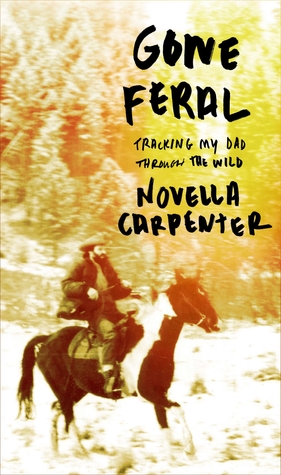

Gone Feral by Novella Carpenter

Gone Feral: Tracking My Dad Through the Wild by Novella Carpenter

I read and liked Novella Carpenter's previous book Farm Cityabout her and her boyfriend farming on an abandoned lot beside their apartment building in Oakland, CA. So, I was excited to read this one about her relationship with her father. When Novella gets a phone call that her dad is missing, as in an official missing person, she freaks out and tries to find him. Soon he reaches out to her (he had just gone out of town without telling anyone), but she realizes that her father is getting older and now is the time to re-establish a relationship with him. Her father wasn't in her life much growing up and the few adult interactions with her dad hadn't been great. After he went missing she visits him and quickly realizes that he's not just a hermit who likes living a simple life in the wilderness, but very likely he's mentally ill. Novella has to work through the idealized image she had of her father with the reality - especially as she is trying to get pregnant with her first child. Novella also has to explore traits of her father that she has and what that might mean for her future as well.

This is an honest memoir of a daughter trying to work out her relationship with her difficult father. It wasn't as apparent (as least from what I remember) in Farm City that she is basically living in poverty, although it seems by choice - apparently that runs in the family as well. I'm far from wealthy myself, but her whole family seemed to be living hand-to-mouth, but on purpose which seems so bizarre to me. It was interesting, if somewhat sad, but in the end she does have hope for her future and she's made peace with her relationship with her father too.
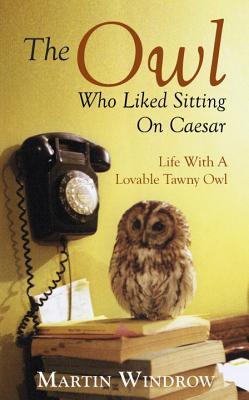

The Owl Who Liked Sitting on Caesar by Martin Windrow

The Owl Who Liked Sitting on Caesar by Martin Windrow

Martin Windrow became fascinated with owls after his older brother got into falconry and also kept a pet Tawney Owl. After one failed attempt with a Little Owl who never bonded with Windrow and escaped, he adopts Mumble a Tawney Owl. Mumble was hatched in captivity and came to Windrow a few weeks after birth. They bonded instantly and living with Mumble would completely change Windrow's life. The personal aspects of the book about Windrow and Mumble's activities was very interesting, but there was a lot of general information about owls and it seemed like too much to me. Obviously you need some background about owls for a story like this, but there were whole chapters just on owl history, biology, etc. that I could have done without. Windrow also mentions that after the first year or so Mumble no longer tolerated visitors well - she would attack them unless Windrow put her into her cage. He never really talked about how that affected his social life, which I'm sure it did in a big way. Overall, it had interesting parts, but it wasn't great. I liked Wesley the Owl by Stacey O'Brien much better.


Eating Wildly by Ava Chin

Eating Wildly: Foraging for Life, Love and the Perfect Meal by Ava Chin

Ava Chin is approaching 40 and is still single, her beloved grandmother is dying, she struggles with her relationship with her Mom, and her relationship with her Dad is non-existent. To deal with all this she escapes into foraging for wild food in New York City. She even lands a column in The New York Timeswriting about being an "urban forager." In foraging for wild food Ava learns how to navigate the tough circumstances she's dealing with - and later her foraging even leads, finally, to true love.

This was a quick read that was interesting. Chin's personal stories/problems don't overwhelm the book and each chapter also includes a recipe using wild food. I did like it, but it wasn't fantastic. Since it was such a quick read I would recommend it to anyone interested in foraging or food issues.


July 2014 Cookbooks

The New Cast Iron Skillet Cookbook: 150 Fresh Ideas for America's Favorite Pan
The New Cast Iron Skillet Cookbook by Ellen Brown

I was lucky enough to inherit a few pieces of cast iron cookware and this book has inspired me to pull them out and get them seasoned and ready to cook with. The author gives a chapter at the beginning of the book about the benefits of cooking with cast iron and how to season and care for cast iron cookware. Then it's broken down like a traditional cookbook with breakfast, sides, main dishes, breads, and desserts. There were lots of great recipes I'd like to try. This one will make you want to ask your grandmother if she has any old cast iron pots around you could "borrow" for awhile.


The Real Food Cookbook by Nina Planck

The Real Food Cookbook by Nina Planck

As the subtitle reads, this book is full of "traditional dishes for modern cooks." The author describes changing from trying to eat a supposedly more healthy vegetarian diet, to changing to what she calls "traditional foods," including meat, dairy, and fat which are often disparaged as unhealthy. There are lots of yummy sounding basics that look very easy to pull together quickly. It's broken down like a traditional cookbook with appetizers, salads, soups, sides, main dishes, etc. But, I like that at the end there are a few pages about how to source good, local ingredients - which makes a big difference in my opinion. There are definitely a few recipes I'd like to try from this. Another great cookbook for anyone looking to make more homemade, traditional food.


The Nourished Kitchen by Jennifer McGruther

The Nourished Kitchen by Jennifer McGruther

This cookbook has TONS of great, seemingly very easy recipes for basics and staples that most people use all the time. I am a firm believer that doing things from scratch or homemade can sometimes be even easier than the "convenience" ways. I also think society and media have steered us away from using traditional things like lard that is rendered from pig fat to seemingly "better" options that are just full of chemicals. There are recipes for homemade sour cream, lard, curing your own bacon and more traditional recipes too. There are quite a few things I hope to try from this one. If you're interested in more traditional and homemade ways of cooking this one is for you!


Tuesday, July 8, 2014

July 2014 Reviews

The Last American Man
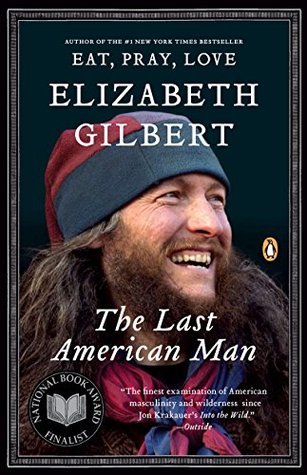
The Last American Man by Elizabeth Gilbert

This was a very unique and odd book about a unique and odd man named Eustace Conway. Conway was born in South Carolina, but mostly grew up in Gastonia, NC. Through his parents he developed an intense love of nature and being outdoors. He taught himself TONS of survival skills and studied Native American and other indigenous cultures to learn more natural ways to live. Conway's father, also named Eustace Conway, was an incredibly demanding and exacting man and he constantly let Conway know what a disappointment he was as a son - even though Conway was incredibly skilled and talented. Unfortunately this terrible relationship with his father would be a constant shadow on Conway's otherwise incredible life. He experienced things only a handful of people in the world ever experience. He devoted his life to trying to teach other how to live a more meaningful and natural life. But, he was also very similar in personality to his own father and most people could never live up to his expectations, which strained most of his relationships. Conway lived on 1,000 acres outside of Boone, NC called Turtle Island. He acquired his land piece by piece and wanted nothing more than to live his back-to-the-land existence with a family, but it hasn't happened, at least by the end of this book anyway. While Conway's story is fascinating, it is also sad because from the outside it's obvious that his strained relationship with his father has affected him so much. Being from North Carolina myself, I can't believe I'd never heard of Conway until I found this book. He is an incredibly accomplished person who's led a unique and fascinating life. At the end of this book I'm curious to know more about Conway and what he might be doing now.

Some quotes I liked:

"So Eustace pulled out a huge map and unfolded it before him, as if he were a pirate. His land was blocked out in small and large connected parcels, and he told me how he'd acquired each piece over the years. What emerged was a portrait of genius. Eustace had put the thing together like a chess master. He first bought the 107 acres that made up the valley of Turtle Island, and then, as he earned money over the years, he slowly bought the peaks of each hill that surrounded the valley. The peaks of a hill are the most valuable real estate to developers, after all, since everyone wants a home right on top of a mountain. By securing those peaks, then, Eustace had made the hills below them much less attractive to any roving land speculator and therefore much less likely to be sold to someone else before he could afford to grab it...Once he owned the crests, he filled in the gaps, buying the slopes that connected his valley to the surrounding mountaintops. In this way, he guarded his watershed. What he was doing, actually, was transforming his holdings from a small, flat, low-lying basin into a large teacup - a perfect valley - which would be protected by mountains on every side." (p. 116-7)

"My initial reaction on witnessing Eustace Conway's life was relief. When I first heard of his life and adventures, all I could think was Thank God. Thank God somebody in America was still living this way. Thank God there was at least one genuine mountain man, frontiersman, pioneer, maverick out there. Thank God there was one truly resourceful and independent wild soul left in this country. Because, at some deep emotional level, Eustace's existence signified to me that somehow it's still true, that we Americans are, against all other available evidence, a nation where people grow free and wild and strong and brave and willful, instead of lazy and fat and boring and unmotivated." (p. 125)

"Jason was the very model of the young guy who typically comes to Eustace Conway for guidance. He was trying to discover how to be a man in a society that no longer had a clear path for him. Just as Eustace Conway had struggled as a teenager to find rituals to lead him into manhood, Jason was struggling to find some ceremony or meaning that would help define his own ascension. But he had no role models, his culture had no satisfying coming-of-age ritual for him, and his background had provided him with none of the manly skills that were so attractive to him. He was, by his own admission, lost." (p. 202)


The One & Only by Emily Giffin

The One and Only by Emily Giffin

I really like Emily Giffin, but this one was not one of my favorites. The story follows Shea Rigsby who from a very young age LOVED football - specifically the college team of her hometown of Walker, Texas. It also didn't hurt that her best friend Lucy is the daughter of Coach Carr, the head football coach at Walker. Fast forward to Shea's mid-thirties and even though she's working on staff at Walker, her life feels stuck. She knows she's just coasting and could be doing more with her life. When Coach Carr recommends her for a new job and she starts dating the star quarterback of the Dallas Cowboys it looks like Shea's life is starting to shape up. But, she still feels like something is missing. When she starts to realize what she really wants Shea has to decide if it's worth taking the risk or if she'll keep taking the safe route.

There was enough going on in the storyline that I wanted to keep reading to see what would happen, but it also felt very scattered and there was a LOT going on. There was also a LOT of football - which I'm not super interested in, but it was important to the story. I did like the overall theme of fighting for love and that you don't choose who you fall in love with, but I just didn't like the feel of the book. I still really like Emily Giffin, but this wasn't her best book.


Sous Chef by Michael Gibney

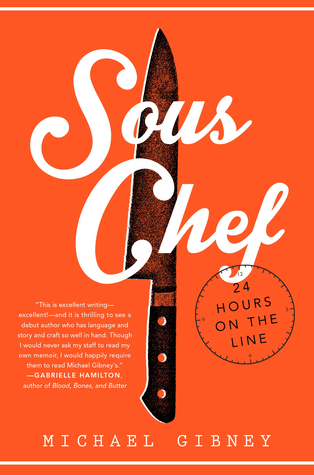
Sous Chef by Michael Gibney

This is one of those books that leaves you almost exhausted at the end. Michael Gibney takes you through a typical day in a higher-end restaurant working as the sous chef. The sous chef is one step down from the head chef, so there is a lot of hard work and responsibility involved. Gibney does a great job walking someone unfamiliar with a restaurant kitchen through a typical day working on the line. It definitely makes you appreciate the kind of hard work that goes into running a smooth restaurant. I wish I had been able to just sit down and read this book in one sitting since it only covers one 24-hour period. There are also a few pages at the end that defines kitchen terminology, some of which Gibney defines throughout the book. I would recommend this one for anyone interested in chefs and restaurant work.


Problems with People by David Guterson

Problems with People by David Guterson

I'm not much for short story collections, but I really like David Guterson so I decided to try this one. I didn't like it at all. All of the stories are about people dealing with grief or loss, but you didn't even really like most of the characters themselves. Almost all of the stories had a very uncomfortable feeling, which a little of that is OK, but the whole thing?! Overall, it was just not good in my opinion.


A Wolf Called Romeo
A Wolf Called Romeo by Nick Jans

In the winter of 2003 Nick Jans encountered a lone wolf near his Juneau, Alaska home. Having seen wolves in the wild before, but only rarely he is amazed at how much this wolf seems to seek out human and canine attention. Over the next few years Romeo, as the wolf becomes known locally, interacts with dozens of humans and dogs - always seeking the interaction himself. Within a few years though there are a faction of local residents who are not happy about a wolf hanging around so much. There is also the increasing problem of Romeo's popularity with local residents who are thrilled to have the chance to see a wild wolf so close. Jans knows that this increased attention to Romeo could easily backfire if the wolf feels threatened and lashes out. Jans is also worried about dog owners who don't have control of their dogs or have aggressive dogs - although he never personally saw Romeo react poorly to an aggressive dog. But, unfortunately in 2009 at trophy hunter from Pennsylvania comes to Juneau with the intent of killing Romeo solely because of his local popularity. He does and when locals like Jans find out they bring it to the attention of local authorities. The trophy hunter is arrested, along with his friend who is a local resident, but their prosecution is a joke and shows that even with an animal like Romeo - in Alaska it's just another wolf that's been hunted illegally.

While Romeo's story does have a sad ending, his impact is still felt on the community in Juneau. Especially with a few people like Jans who had a more long-term, intimate relationship with Romeo. Interspersed throughout Romeo's story Jans also gives a lot of information about wolves and shows just how unique the situation with Romeo was. He also gives a lot of the complicated and sad history of human interaction with wolves, both in the Continental US and specifically in Alaska. He also includes a few beautiful pictures of Romeo that he took over the years of their interactions. Overall, even though the end is sad, this is an incredible book about a very unique wolf and how much he impacted a small community over just a few years.


The Bees by Laline Paull

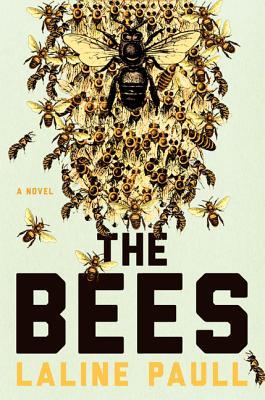
The Bees by Laline Paull

Flora 717 is a sanitatation bee who is born into the lowest caste in her hive. The sanitation bees clean up after the other bees and remove dead bees from the hive. But, from the very beginning Flora 717 is different. She is curious and smart and doesn't just go along with what's expected of her - which is very little. She quickly is able to feed newborns in the nursery, she works as a forager gathering pollen and nectar to make into honey, she then helps fight off a wasp which grants her seldom-given access to the Queen. Soon Flora 717 is doing things that are NEVER done in the hive - things that put her life in jeopardy. The motto of the hive is Accept, Obey, and Serve, but Flora 717 is starting to realize things must change in order for the hive to survive. She uncovers secrets and risks her life to do what she knows is right even if no one else agrees. In the end her courage to go against the hive mentality of Accept, Obey, and Serve will change not only her life, but the life and future of the hive.

This is one of the most unique and interesting books I've read in a really long time. On one level it's a unique look at the culture of a beehive from an "insider's" perspective, but on another level it's also a story about power, hierarchies, risk, and the importance of believing in yourself and doing what is right no matter what. A fascinating book that I just could not put down.

Exodus: A Memoir
Exodus by Deborah Feldman

I loved Deborah Feldman's first memoir Unorthodox, where she described growing up in the Hasidic Jewish community and making the decision to leave. Exodus picks up shortly afterUnorthodox ends. She has to work out how to support herself and her son and make the HUGE adjustment to life outside the rigid and secluded Orthodox Jewish community. Feldman is also trying to work out how she can connect with her Jewish heritage and religion outside of the Hasidic community. In order to work through a lot of her issues she travels across the US and decides to trace her Grandmother's roots in Europe - starting in Hungary where her Grandmother was born to the concentration camps in Germany that her Grandmother survived. Feldman discovers a lot on her European journey, unfortunately one thing she finds is that there is still a lot of anti-Semitism there. She struggles the most in Germany thinking about all that happened to the Jews there because of the Nazis. Incredibly though she also falls in love with a German man who's grandparents were Nazis!

Overall, I think this book was almost as good as Unorthodox. The story is not strictly chronological, but it works. She walks through some of the journeys she took to discover herself after her Exodus and also explores her family's Holocaust history and shows just how much that affected her growing up and still today. My only complaint was there was some definite weirdness/awkwardness with her relationship with the German guy who's grandparents were Nazis - she was very conflicted about their relationship even though he was ashamed of his family's history. There were a few weird/uncomfortable sexual scenes that I did not need to know about with him. But, overall it was a really good book and I definitely enjoyed it. I look forward to her future work.


Goodnight June by Sarah Jio

Goodnight June by Sarah Jio

This was a really enjoyable and light read. June Andersen is a successful vice-president of a banking company, but she works 60+ hours a week and has absolutely no personal life. When she finds out that her beloved aunt Ruby died and left June her children's bookstore Bluebird Books in Seattle, WA, June thinks she'll fly out for a week and get her aunt's bookstore ready to sell. But, once she gets there she remembers how much her aunt and the bookstore meant to her as a child. She always loved reading, but now barely has time to sleep much less read for pleasure. She also starts to unravel some secrets about Bluebird Books, but also about her aunt's life. As June starts to understand the secrets of Bluebird Books she realizes there is an important connection between her aunt and Bluebird Books and the famous children's author Margaret Wise Brown and her most famous book Goodnight Moon. Soon June has quit her banking job and decided to make a go of running Bluebird Books. Will she be able to save Bluebird Books and reinvent her life? 

There were a few things that were pretty predictable, but not painfully so. There was also a weird storyline with June's sisters Amy that I felt like didn't really work and didn't add much to the overall story - I think that whole part could have been left out completely. But, overall I did like the story and even though it was somewhat predictable I still wanted to keep reading and see it all play out. A fun and light-hearted read with a happy ending.


Tuesday, June 10, 2014

June 2014 Reviews

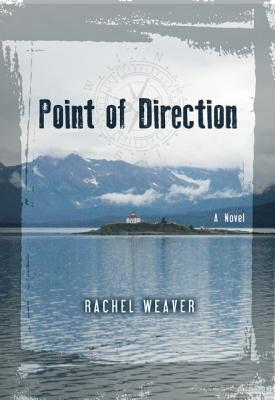
Point of Direction by Rachel Weaver

Point of Direction by Rachel Weaver

I don't know how this book was ever characterized as a "psychological thriller" because it was definitely not in my opinion. It was more of a "coming of age" for adults type of book. Anna meets Kyle while hitchhiking in Alaska. She is running from an event in her past, but being with Kyle seems to help. When Kyle wants to sign up to live on a remote lighthouse Anna actually thinks it might be the best thing for her to deal with her past. But, life is harder than they realized it would be and while Anna actually enjoys the challenge it seems to make Kyle edgy and irritated - and they aren't even close to winter yet. Anna also finds out that Kyle has been running from a problem in his past too and it might be closer to them than they realize. Both Anna and Kyle must confront their demons in order to move on whether together or individually.

I was really expected more tension or crazy events, but most of the book was pretty dull. There were a few moments of action, but overall it was more Anna in her head trying to sort things out for herself and realizing some things about Kyle along the way. It was OK and I did want to know what happened at the end, but it wasn't great and I wouldn't really recommend it.


Year of No Sugar by Eve O. Schaub

Year of No Sugar by Eve Schaub

After Eve Schaub and her husband watched a YouTube video by Dr. Robert Lustig about sugar actually being a poison in our bodies, they make the radical decision for their family to eat NO added sugar for one year. At the time their children are 11 and 6 years old too. They do make a few exceptions - one "real" dessert each month, and each family member can pick one exception item. While I applaud the Schaub family for their experiment, I think the larger point from this book is just how much of our food now has added sugar in it - things that you wouldn't think like condiments, salad dressing, meats, etc. I was also impressed at how well her children did, but they were never eating McDonalds every day to begin with either. This is yet another book that shines a light on how unhealthy processed food is today and how so few people even think about it at all. Food is what fuels us so what is in our food should be priority #1! I also found it interesting that as their experiment went on Eve's taste buds began to change. In her words her mind still craved sugar, but her palate didn't. At the end of the book they do keep many of their diet changes, but they relax a little more and do eat sugar, but they are much more aware of just how much sugar is hidden in everyday food. I would recommend this one to anyone who cares about what is in your food.

Some quotes I really liked:

[From Dr. Lustig's video] "As a society, we all weigh twenty-five pounds more than our counterparts did twenty-five years ago...Even as our total fat consumption has gone down, our obesity has continued to accelerate...Simply drinking one soda per day is worth fifteen pound and a half pounds of fat gain per year...Americans are currently consuming sixty-three pounds per person of high-fructose corn syrup per year..." (p. 8)

"Part of the problem is that as parents and as a society, we are providing too many choices. Did Laura Ingalls refuse to drink her milk if it wasn't chocolate? To eat her cereal if it didn't have Day Glo marshmallows in it? I have to believe that, if your kid is hungry enough, they'll eat. If they're thirsty enough, they'll drink. Are Frosted Flakes and Lucky Charms really the best we can do?" (p. 119)

"What Rhonda's comment made me realize is that it's all well and good to demonize sugar when you're talking about the Big Bad Corporations sneaking high-fructose corn syrup into our ketchup and mayonnaise; it's another thing entirely to go after Grandma's lovingly baked molassas cookies. The problem is, nutritionally, your body can't tell the difference between the 'bad' sugar (from Big Food Inc.) and 'good' sugar (from Grandma). Fructose is fructose. And an excess of fructose consumption, now at its highest levels ever and still climbing, is making our society sick." (p. 140)

[After the experiment] "But, the thing is, we are weird. We were weird before - not eating at McDonald's and avoiding soda. And we're weird now - avoiding juice and crap sugar food (doughnuts, cookies, free lollipops), as well as anything that sweetened when we know it needn't be: dried fruit, chips, crackers, tomato sauces. We had become much, much more selective about the sugar we do consume, and in a culture like ours - which is utterly saturated with sugar, convenience food, and fast food - that's weird." (p. 260)

[from Stephen Schaub] "But what I have learned is that it is the food industry in our country that is really the extreme; eating local, fresh food - not loaded with needless added sugar, preservatives, additives, chemicals, and general crap - is really what should be considered normal. Because it is normal. It was normal for thousands of years." (p. 267)


Sea Creatures by Susanna Daniel

Sea Creatures by Susanna Daniel

After Georgia's business goes under and her husband Graham is fired from his professor position in Illinois, they decide to move back to Georgia's hometown of Miami. One of Graham's friends has gotten him a position working on hurricane research. Their family is dealing with not only the scandal that cost Graham his job in Illinois, but also the fact that their 3-year-old son Frankie has stopped talking. Once in Miami, Georgia finds part time work running errands for an reclusive artist because she can bring Frankie along on the errands. Spending time with the artist helps Georgia begin to see what may be behind her son's speech issues and the best way to help him. As more of Graham and Georgia's story unfolds, Hurricane Andrew is brewing in the Atlantic. When the epic storm hits all hell breaks loose - for Florida, but also in Georgia's life. Once the storm dies down Georgia has to decide how best to move on for herself and for Frankie. 

I didn't really have any expectations for this book before I read it, but I was blown away and just could not put it down. The way the author unfolds the plot is unique and I didn't see any of the ending coming ahead of time. I also liked how the book was realistic and everything didn't work out in a cookie-cutter perfect way. This was a very unique book that explored a lot of issues - love, family, sleep disorders, selective mutism, the ocean, loss, and grieving.


The Meat Racket: The Secret Takeover of America's Food Business
The Meat Racket: the Secret Takeover of America's Food Business by Christopher Leonard

The Meat Racket explores the modern, industrial meat industry through the lens of one of the major companies - Tyson Foods. Christopher Leonard explores the rise of the industrial chicken industry that John and Don Tyson created and how that business model shaped all other industrial meat industries. I've read a lot about this topic and was very familiar with CAFOs (Concentrated Animal Feeding Operations), but had no idea that Tyson basically created the first CAFOs for chickens and the other meat industries followed suit because there was no other way to compete with Tyson without CAFOs. This book also reiterates the illusion of choice that consumers have with industrial meat - there are only a handful of companies that control almost all the consumer meat. There may be various company names on packages of meat at the grocery store, but almost all of those companies are fronts for the illusion of choice and are owned by one of the few meat giants like Tyson. Leonard also explores some of the most unscrupulous practices of Tyson and how terribly they treat their farmers. Basically the fastest way to work yourself to death and end up bankrupt is to become an industrial chicken farmer. Some of the stories from the ruined farmers are heartbreaking. This is a really great overview of the industrial meat industry by examining one of the biggest players and leaders in this horrific industry. Definitely an eye-opening book!

Some of the many quotes I really enjoyed:

"Just a handful of companies produce nearly all the meat consumed in the United States, and Tyson is the king among them. The company sits atop a powerful oligarchy of corporations that determines how animals are raised, how much farmers get paid, and how meat is processed, all while reaping massive profits and remaining almost entirely opaque to the consumer...[this is]a system that keeps farmers in a state of indebted servitude, living like modern-day sharecroppers on the ragged edge of bankruptcy." (p. 3)

"Tyson could roughly predict which chicks would be healthy based on the age of the hens that laid the eggs. Older hens produced weaker chicks, while younger hens laid more vigorous broods. Edwards noticed that some farmers were consistently receiving chicks produced by the healthiest, youngest hens. Whoever was setting up the deliveries in the Broiler Office was giving these farmers the cream off the top. And he noticed something else: Other farmers were consistently getting the batches of culls. As Perry Edwards pored over the shipping logs, he saw that the pattern was the same. When there were bad batches of birds, they went to the same group of farms. And the healthiest birds also went to a select group of farms that, not coincidentally, always ranked as the highest paid farms in the network." (p. 37)

"Cash-basis accounting is simple. A company records its expenses only when it pays out the actual cash for them. And it only books income when the actual cash comes in the door. By contrast, companies using accrual accounting methods record their expenses when they sign a contract to pay someone, even if the cash hasn't actually left their account yet. Farmers were allowed to use cash-basis accounting because it was simpler, and Congress didn't think small farms had the money to hire accountants for complicated recordkeeping...By 1985, Tyson's Foods had avoided paying $26.5 million in annual taxes through the cash-basis loophole, according to a report written by two economists with the U.S. General Accounting Office. The morality of the ploy didn't seem to be a matter of much debate inside Tyson. When the company saw a loophole and a chance to make a profit, Tyson took it, a strategy that became part of the company's culture for decades to come...In 1986 Tyson was forced to quit using the scheme when the Tax Reform Act closed the loophole for farms with more than $25 million a year in gross recipts." (p. 72-4)

"At the end of any given week, a series of letters is mailed out from the Tyson complex in downtown Waldron...The letters are several pages long and packed with complicated financial figures. The farmers call them settlement sheets. The one critical piece of information the settlement sheets contain is the going price of chicken, or, more accurately, the price that Tyson deems appropriate to pay. Each farmer receives his own price, determined by the tournament system that ranks each farmer against his neighbor. At the end of each week, Tyson makes a competitive pool out of all the farms that have delivered chickens to the plant. The company has far more data about the farms than their owners; the company can compare how much feed each farm consumed compared to its neighbors, how many birds died and how much weight gained overall...All this information is fed into an equation that spits out a simple ranking: the most efficient farms on top, the least efficient at the bottom...But there are critical pieces of information that Tyson keeps secret. The company doesn't tell the farmer whom he competed against in a given tournament...If a farmer ranks near the top, he might earn 5 cents a pound for his labor. If he ranks in the middle, he would get paid 4.5 cents. Close to the bottom, he would make 4.1 cents...When a farmer gets hammered in the tournament, it might seem prudent for him to approach his neighbors and ask what they were doing differently. This is tough to do, and not just because the names on the tournament ranking are left blank. Each page is clearly marked with the warning: 'Confidential and Proprietary Information of Tyson Foods, Inc.' If farmers were to meet and compare their settlement sheets, or show them to a journalist or lawyer, Tyson can sue them for leaking confidential information." (p. 115-117)

"The tournament system is kept afloat by an obscure federal organization called the Farm Service Agency. The FSA spends hundreds of millions of dollars in taxpayer money to make sure that there will always be cheap loans for a new chicken farm when an older one is put out of business...While the agency was limited in how much money it could loan directly to farmers, it had far more leeway in the size of the loan it could guarantee. Under the guaranteed loan program, the FSA would pay back the bank more than 90 percent of the loan value if a farmer defaulted...Between 1999 and 2009, the Arkansas FSA office alone guaranteed more than $797 million in new loans, leaving taxpayers on the hook if the farms failed...It's difficult to determine how much money taxpayers spend every year to support Tyson's system of contract farmers. Clearly, billions of dollars underpin the construction of new chicken farms in the United States. This steady flow of easy credit allows Tyson and its competitors to cast off farmers without worrying that banks will hesitate to lend money to the next chicken grower in line." (p. 139-143)

"The free market had very little to do with the U.S. food market anymore. The USDA, for example, centrally controlled how many acres of corn were planted each year. This wasn't as completely Sovietesque as it sounds: The production controls weren't mandatory. Farmers could plant as many acres of corn or wheat as they wanted. But if they didn't comply with the USDA's state production levels, the farmers got cut out of government subsidies. In essence, the USDA bribed farmers to go along with its central planning regime. And it worked remarkably well...In 1996, Congress ended the farm subsidy program with a new farm bill called the Freedom to Farm Act. Strangely enough, Freedom to Farm only enlarged the farm subsidy program and made it much more expensive...In 1998 taxpayers handed over $12.4 billion to farmers, and in 1999 they paid $21.5 billion, nearly triple what they paid before Freedom to Farm was passed. While it didn't end subsidies, Freedom to Farm made one critical change that benefited Tyson Foods. The law disbanded production controls. Farmers got their government checks, and they could grow whatever they wanted. When the production controls went away, farmers did what they do best: They massively overproduced. The world was glutted with corn, wheat, and soybeans. Prices plummeted, farmers bemoaned the low prices, and taxpayers subsidies grew rapidly to cover farmers' losses. This cycle led to a remarkable gift for meat producers. Feed grains were the biggest cost that Tyson Foods had to pay to raise animals. If feed grains got too expensive, the company's profits could quickly vanish. Freedom to Farm didn't just make grains cheaper for Tyson. The federal program went so far as to produce an upside-down food economy, where corn was actually cheaper to buy than it was to grow....For industrial hog producers alone, Freedom to Farm delivered about $947 million a year in savings, according to one study." (p.165-6)

"On the meatpacking side, there are now just four companies that buy 85 percent of the cattle sold in the country. Tyson is the biggest, followed by Cargill, JBS Swift, and National Beef. As meatpackers have become bigger, feedlots have tried to keep pace, expanding to meet the needs of their corporate buyers...What has evolved is a kind of de facto vertical integration, with whole networks of feedlots tied to meatpackers under contract. The cattle market is technically an open one, but no one behaves that way, and it's an open secret that they don't. There is ample evidence that the big four meatpackers have chosen to divvy up the market, picking territories where they can buy all the cattle from a feedlot without facing a competing bid." (p. 208-9)

"While Tyson has been the architect of this system, the driving force behind it has been the American consumer. Americans have decided that meat must be cheap and plentiful. It must be consistent in its attributes and predictable in its taste. It takes factory farms to raise meat like that. It takes companies like Tyson. It takes networks of chicken farmers integrated tightly with big slaughterhouses like the one in Waldron. It takes a steady flow of genetically selected pigs from the nursery in Holdenville, Oklahoma, that are shipped to contract farms in Iowa for raising. It requires massive feedlots, controlled by contracts, that can guarantee a nonstop supply of cattle. The system also requires the rules that Tyson has imposed. This is what delivers the cheap pork chop, the Zilmax-infused hamburger patty, and the ever-ready supply of chicken McNuggets." (p. 226-7)

"Industrial food lobbyists know it's smart to stick together. A regulation over one of them could open the door to regulation over others. By pooling their money and time, they present a united wall against any legislation that might change the power structure of American agribusiness. They fight together, and they profit together. Meat lobbyists hold regular conference calls, sharing tips and news and planning future campaigns." (p. 251-2)

"The biggest meat companies - Tyson Foods, ConAgra Foods, Cargill, Smithfield, and JBS - spent a combined $5.94 million on lobbying during 2010 alone, according to an analysis of disclosure reports. Tyson had the biggest lobbying operation by far, spending $2.59 million." (p. 286)

"In 68 percent of the counties where Tyson operates, per-capita income has grown more slowly than the state average over the last forty years. Tyson counties, in other words, were worse off in terms of income growth than their neighbors, even as Tyson's profits increased...But the data suggests that Tyson is a suffocating economic force on the communities from which it derives its wealth. Without question, the company provides thousands of jobs and steady paychecks. But its cost-cutting ethos and the lack of competition restrains income growth in rural America. The company has expanded in economically marginal areas, and it has kept those areas economically marginal. Tyson Foods is feeding off the lowly economic position of rural America, not improving it." (p. 315-6)


Lies You Wanted to Hear by James Whitfield Thomson

Lies You Wanted to Hear by James Whitfield Thomson

This was a really interesting book. When Lucy and Matt meet it's love at first sight for him, but Lucy is still hung up on her on-again, off-again jerk ex-boyfriend Griffin. Matt is perfect on paper, but she knows she'll never love him like he loves her. But, when she finds out she's pregnant she decides to make a go of it with Matt. But, a few years later Griffin comes back on the scene and Lucy just can't resist him. I don't want to give anything away, but both Matt and Lucy have to deal with the consequences of their relationship and how that affects their children. When Matt does something drastic, Lucy realizes just how much she loves her kids and the lengths she would go for them. Overall it was a really interesting book that really makes you think about how every act has long-term consequences even when you think you're doing the "right" thing. I did think the ending was a little too vague and that's why I didn't give this one more stars. The story definitely kept me going wanting to know what would happen next, but I don't like vague endings.


Yin, Yang, Yogini by Kathryn E. Livingston

Yin, Yang, Yogini by Kathryn Livingston

Kathryn Livingston was always a worrier, but it's gotten worse for her since her mother died. Her mother was a worrier too and they worried about everything together. When one of her sons signs up for a month-long class in Europe she really starts to freak out about him being on the plane and so far from home for a month. She starts seeing a therapist to deal with her anxieties and they suggest she try yoga before going on medication to calm down. The book chronicles her first 2 years of practicing yoga. In the second year she is diagnosed with breast cancer and that's when she really sees the changes that yoga has brought in her life. She learns to stop being afraid of everything and dwelling in the past. Yoga teaches her to enjoy the moment and not worry about the past or the future, but just to be in the moment.

I've been practicing yoga for about 6 months now and I love it. I thought I would love this book, but it just wasn't great. While you do see Livingston change and grow through yoga I didn't like the tone of the book - it almost seemed complaining even when she was talking about good things. It also seemed very repetitive and wordy. Overall, I would recommend going to yoga instead of reading this book about Livingston's experience with yoga.


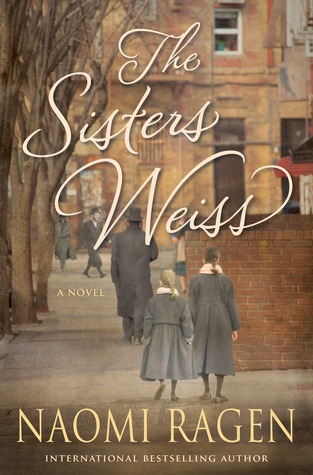
The Sisters Weiss by Naomi Ragen

The Sisters Weiss by Naomi Ragen

Rose and Pearl were not only sisters, but best friends when they were children. Growing up in an ultra-orthodox Jewish house Rose had a lot of responsibilities from a young age, including helping care for her younger sister Pearl. When Rose innocently borrows a book from her friend her parents freak out because the book has "indecent" pictures in it and banish Rose to a new school and living with her grandmother. From that time on Rose realizes that she will never have a say in her own life if she stays with her family. On the eve of her arranged marriage she runs away and never looks back. Pearl is heartbroken after her sister leaves and Rose's decision to run away also has a huge impact on Pearl's life. 40 years later Rose and Pearl finally interact again, but not because of something good. Pearl's youngest daughter Rivka has run away from home and show's up at Rose's daughter Hannah's house. Rivka's decision to run away stirs up a lot of memories and feelings for Rose. It also is what finally brings the two sisters back together after 40 years apart. An interesting look at the orthodox Jewish life from two perspectives - Pearl who stayed and Rose who left. Through Rose and Rivka's stories you also see that even when you run away from your past and family - it never really leaves you. 

I thought the ending felt kind of rushed and crazy, but overall I really liked the book. I do wish there had been more of Rose's back story of her life when she ran away - there is some, but not enough. Overall, I really liked it and it explores a unique segment of our society.


Chickens in the Road by Suzanne McMinn

Chickens in the Road by Suzanne McMinn

After Suzanne McMinn's divorce she decides she wants to live somewhere with "chickens in the road" and decides to move to West Virginia where her father's family is from. Suzanne grew up spending time in West Virginia, but has never actually lived or worked on a farm. She and her 3 children move to a very small community and she begins working on her farm. Once in WV she meets the man she calls "52" and they decide to buy land and build a house and farm. It's VERY obvious from the very beginning that 52 is an asshole and their relationship won't last, but Suzanne tries because she loves the farm so much. Finally she begins to realize that she CAN support herself and live her own dream without someone like 52 in it making her life miserable. While a lot of the book is about her tumultuous relationship with 52 there is a lot of great stuff about the farm and Suzanne trying to live more self-sufficiently on the farm. The end of the books has a lot of recipes and craft projects too. After reading the reviews of this book I wasn't sure how much I was going to like it, but I liked it more than I thought I would. I definitely want to try out some of her recipes too!


My Wish List by Gregorie Delacourt

My Wish List by Gregoire Delacourt

This is a very odd little book. It was so short I finished it over the course of one day. The story follows Jo, who lives an average life with her husband and almost grown children. She owns a fabric shop and is mostly content with her life. When two of her friends convince her to play the lottery she wins 18 million euros! But, Jo doesn't tell anyone that she won. She is worried that the money will change things between her and her husband. But, then he betrays her in a terrible way. He seemed like a terrible husband, so I'm not sure why she wanted to keep their life the same. The end of the book is very odd and doesn't really explain everything clearly. It was a very odd book with a not great ending, so I wouldn't recommend it. The only redeeming part was that it definitely makes the point that money can't buy happiness.